Table of Contents
- What Separates High Quality Home Goods From Mass-Market Items
- How to Spot Quality Furniture: A Room-by-Room Inspection Guide
- Durable Materials for Home Goods: What to Look For and What to Avoid
- The Benefits of Artisanal Home Decor for Your Living Space
- Hardware, Internal Components, and Stress Testing: What Most Buyers Miss
- Certification Labels and Lifecycle Cost: Separating Marketing From Reality
- Frequently Asked Questions
Last Updated: September 30, 2026
What Separates High Quality Home Goods From Mass-Market Items
High quality home goods are products built with durable materials, sound construction, and consistent finishing, so they hold up to daily use and age well instead of falling apart within a season or two. The difference rarely shows up in a product photo. It shows up in the frame, the grain, the stitching, and the hardware.
That gap matters more than most shoppers expect.
How to Spot Quality Furniture: A Room-by-Room Inspection Guide
Learning how to spot quality furniture comes down to three checks: the frame, the joints, and the upholstery. Run these in order, and most poorly made pieces reveal themselves in under two minutes.
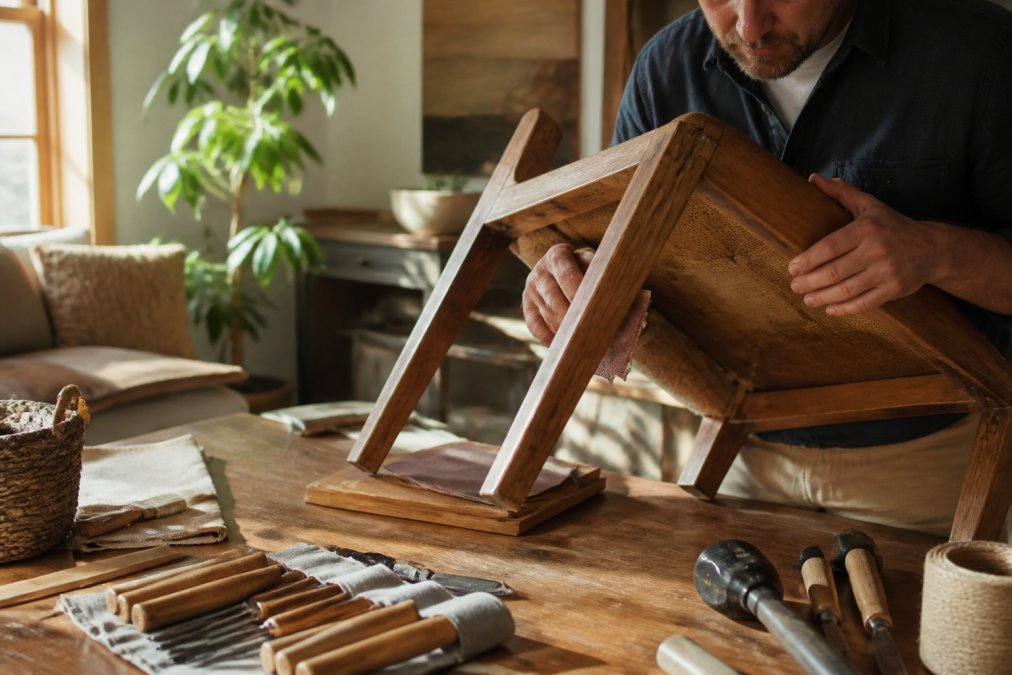
Step 1: Check the Frame and Joints
Lift one corner of the piece a few inches off the floor. A well-built frame stays rigid; a weak one twists and creaks. Then look underneath. Dovetail joints, where interlocking wedge shapes lock two boards together, signal real craftsmanship because they take time to cut and resist pulling apart under load.
Step 2: Examine Upholstery, Stitching, and Seams
Press the fabric across a seam. On a durable piece, the stitching stays tight and the pattern lines up across cushions. On a cheap one, seams pucker, thread pulls, and the fabric feels thin enough to see light through. Check the underside too: a stapled dust cover usually means corners were cut elsewhere.
Durable Materials for Home Goods: What to Look For and What to Avoid
Durable materials for home goods share one trait: they can be repaired. Solid wood, dense natural textiles, and metal hardware with real weight all fall into that category, while particleboard and thin synthetic blends usually do not.
Solid Wood vs. Veneer: Reading the Grain
Turn the piece over and look at the grain on the top and the underside. On solid wood, the pattern continues and looks slightly different on each face. On veneer, the grain repeats identically and often stops dead at the edge. Veneer isn't automatically bad, but it delaminates when moisture gets under it, and it can't be sanded back.
Textile Density, Weave, and Thread Count
Hold a textile up to the light. Dense weaves block most of it; loose ones glow. Higher thread count isn't automatically better, since a tight percale weave at a moderate count can outlast a loosely woven high-count sheet. Texture tells you more than the number on the tag.
The Benefits of Artisanal Home Decor for Your Living Space
The benefits of artisanal home decor come down to longevity and character rather than trend appeal, but those words only mean something if you can verify them. A hand-finished piece develops patina over years of use, which is the soft sheen and depth that mass-produced finishes never reach. It also tends to be repairable, so a loose joint or worn surface can be fixed instead of replaced.

| Sign | What It Indicates | Where to Check |
|---|---|---|
| Visible dovetail joints | Strong, repairable construction | Drawer corners |
| Continuous grain | Solid wood, not veneer | Undersides and edges |
| Dense, opaque weave | Durable textile | Hold up to light |
| Substantial hardware weight | Metal, not plated alloy | Hinges and pulls |
| Tight, aligned seams | Careful finishing | Cushions and corners |
| Uneven sheen in raking light | Hand-applied finish | Tops and inside corners |
Hardware, Internal Components, and Stress Testing: What Most Buyers Miss
Hardware is where quality control quietly disappears. Open and close a drawer or hinge several times and listen. A solid brass pull feels cool and heavy; a plated one feels light and warms instantly in your hand. Internal components matter just as much: drawer glides, corner blocks, and webbing take the load that the visible surface never shows.
Organic Percale Bed Sheets Set →
Certification Labels and Lifecycle Cost: Separating Marketing From Reality
Certification labels are only useful when a third party audits them, and most shoppers never learn what each one actually verifies. That gap is where marketing lives. Here is what the common labels on home goods mean, and what they don't.
Lifecycle Cost Analysis: Why Cheap Costs More
Our Organic Sateen Bed Sheets Set and Herringbone Cotton Blanket are both reviewed in person before they reach the site, which is the same standard we apply across our dry goods and home comforts.


Frequently Asked Questions
What materials indicate high-quality home furniture?
Solid wood, particularly hardwoods like oak, maple, and walnut, signals durability and structural integrity. Look for dovetail joints in drawers, which interlock for strength without relying solely on glue or staples. For upholstery, natural fibers such as cotton, linen, and wool outperform synthetic blends in breathability and wear resistance. Check whether the listing specifies material composition and weight-bearing capacity. Veneer over particle board is common in mass-market pieces and tends to fail at stress points within a few years, while solid wood develops a patina and can be refinished.
How can you tell if a home decor item is well-made?
Start by examining the finishing: sanded edges, consistent stain or paint, and smooth hardware operation. Flip the item over. High quality home goods have finished undersides and backs, not raw particle board. Check stitching on textiles for even, tight seams without loose threads. Pick the piece up and assess weight; solid materials feel denser than hollow alternatives. Look for certification labels like GOTS on organic cotton or FSC on wood. These standardized labels verify claims about sustainability and ethical sourcing that marketing copy alone cannot.
Why is artisanal home decor considered higher quality?
Artisanal pieces are typically made in smaller batches where the maker controls material selection and construction methods. This means hand-carved details, dovetail joints, and finishing techniques that mass production skips. The benefits of artisanal home decor extend beyond aesthetics: you get design consistency, repairability, and a piece that ages with patina rather than falling apart. Artisans often source materials locally or through certified supply chains, which supports ethical sourcing. The trade-off is higher upfront cost, but lifecycle cost analysis often favors artisanal goods because they last decades instead of years.
What are the hallmarks of durable home goods?
Durability comes down to material composition, construction technique, and hardware quality. Look for solid wood frames with mortise-and-tenon or dovetail joints, high textile density in upholstery, and metal hardware that operates smoothly without wobble. Weight is a useful proxy: heavier pieces generally use more material and have greater structural integrity. Stress points such as chair legs, drawer runners, and blanket seams deserve close inspection. A Herringbone Cotton Blanket made from 100% organic cotton, for example, retains its color and weave after repeated washing because the fiber and construction hold up, not just the surface finish.
How do you distinguish genuine craftsmanship from mass-produced items?
Genuine craftsmanship shows inconsistency in the best way: slight variations in grain, hand-finished edges, and joinery that fits precisely without visible staples or screws. Mass-produced items often have uniform surfaces that hide particle board or synthetic veneer. Look for hardware that feels solid, seams that align, and weight that matches the material claim. Ask whether the maker provides provenance information or certification labels. A piece described as hand-carved should show tool marks or subtle irregularities. If every unit looks identical and the price is unusually low, the construction likely relies on automation and cheap materials.
Are high quality home goods worth the higher price?
Lifecycle cost analysis usually says yes. A $50 sheet set that pills and tears within a year costs more over five years than a $55 organic percale set that lasts three or four years with proper care. The same math applies to furniture: a solid wood table that can be refinished outlasts three veneer tables at the same cumulative cost. Beyond money, durable materials for home goods reduce waste and support sustainability. The key is verifying that the higher price reflects material and construction quality, not just branding. Certification labels and transparent sourcing information help you confirm that.
What should I inspect first when buying home goods online?
Start with the product description for material composition, weight, and dimensions. Look for certification labels such as GOTS for organic textiles or FSC for wood. Check customer reviews for mentions of wear resistance, hardware failure, or color fading after washing. Zoom in on product photos to examine stitching, seams, and finish quality. If the listing does not specify materials or sourcing, treat that as a red flag. Reputable sellers provide detailed specifications and provenance. When in doubt, ask the seller directly about construction methods and where the materials come from.
Mass-market furniture is designed to be replaced, and that's the real cost of a low price. General Store 34: Dry Goods & More curates goods built to be kept, personally reviewing each item for craftsmanship, material honesty, and enduring character before it earns a place on our shelves. Explore the collection and choose pieces that hold their value in daily use. Shop now.